 Bible Hebrew
How to learn Biblical Hebrew on your own
A realistic self-study plan, in about fifteen minutes a day: the alphabet in two weeks, your first verse in week three, and the order to learn the words and grammar in so you are reading real stories within months.
5 min read
Plenty of people want to read the Old Testament in Hebrew. Most of them buy a grammar book, get through the alphabet, hit the verb charts in chapter twelve, and quietly put the book on a shelf. The language is not the problem. The order they learned it in is.
This is a plan for teaching yourself Biblical Hebrew at home, in about fifteen minutes a day, in an order that gets you reading real verses early and keeps you going.
Can you learn Biblical Hebrew on your own?
Yes. Biblical Hebrew is a reading language. You are not trying to order coffee in Tel Aviv or follow a fast conversation. You are trying to read a fixed text, slowly, with help at hand. That is a very good fit for self-study, because nobody is waiting for you to answer.
It also helps that the Hebrew Bible repeats itself. It has roughly 300,000 words, but the same ones come back again and again. The ten most common words make up about a fifth of the text, and the top 100 make up about half. Learn the right 1,200 or so words and you know about 84% of every word on the page. You do not need a huge vocabulary to start reading. You need the common words, first.
Biblical Hebrew or Modern Hebrew?
If your goal is the Bible, learn Biblical Hebrew. Modern Israeli Hebrew grew out of it and shares the alphabet and much of the vocabulary, but the grammar has moved on. The most common verb form in biblical stories, the wayyiqtol ("and he said", וַיֹּאמֶר wayyōmer), is barely used in Modern Hebrew at all.
Pronunciation differs too. The Bible was read with throat sounds and a w sound that Modern Hebrew has lost or merged. Our guide to Biblical Hebrew pronunciation shows each difference side by side. You can read the Bible with either accent, but it is easier to learn one from the start than to switch later.
Step 1: The alphabet and vowels (weeks 1 to 2)
Hebrew has 22 letters, all consonants, written right to left. Five of them change shape at the end of a word. The vowels are small marks under, over and beside the letters.
Do not try to memorize the alphabet in one sitting. Learn seven or eight letters at a time, say each one out loud, and practice reading short words with them before you add more. Two weeks at fifteen minutes a day is plenty. By the end you should be able to sound out a word you have never seen, slowly, like שָׁלוֹם shālōm, "peace".
Step 2: Read your first verse (week 3)
Most courses make you wait months before you touch the Bible. Do not wait. Genesis 1:1 is seven Hebrew words:
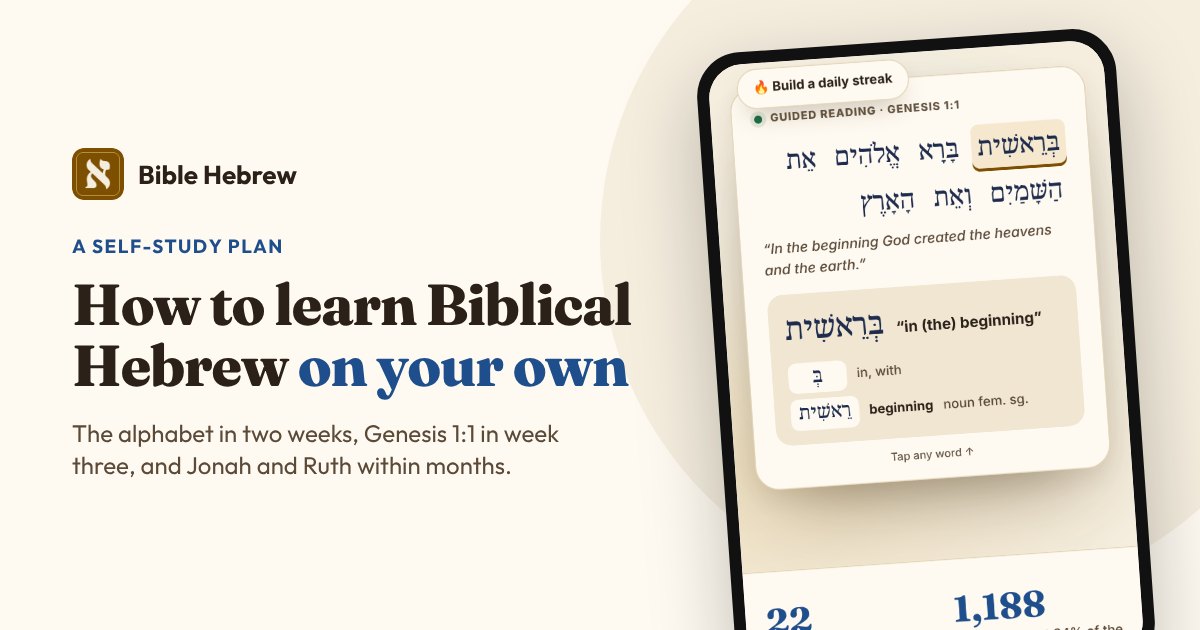
בְּרֵאשִׁית בָּרָא אֱלֹהִים אֵת הַשָּׁמַיִם וְאֵת הָאָרֶץ
"In the beginning God created the heavens and the earth." You will not understand all of the grammar yet, and that is fine. Sound it out, look up each word, and notice that הַ means "the" and וְ means "and". Reading a real verse in week three is what keeps people going through week ten. You can walk through it word by word here.
Step 3: Learn the most common words, every day
Vocabulary is the part self-learners most often skip, and it is the part that decides whether reading feels like a pleasure or a puzzle. Two rules make it work:
- Learn by frequency. Start with the words that appear thousands of times (אֵת, the object marker, appears about 11,000 times) and work down. A list sorted A to Z wastes months on words you will see twice.
- Use spaced review. Review each word right before you would forget it: after a day, then a few days, then a week, then a month. It takes less time than rereading a list and you remember far more. Flashcards with a spaced repetition schedule do this, and so does the app at the end of this post.
Five to ten new words a day is a good pace. At seven a day, you know the 1,200 most common words in about six months.
Step 4: Grammar in small pieces (months 1 to 4)
Learn grammar in the order you will meet it in the text, one idea at a time, and see each one in a real verse before you move on. A good order for beginners:
- The words for "the" and "and", and the object marker: the definite article, then waw and אֵת.
- Noun gender and plurals, adjectives and the construct chain ("the X of Y").
- Pronouns and the endings that mean "my", "your" and "his".
- The verb: the Qal perfect, the Qal imperfect, then the wayyiqtol story verb.
- Later, the seven verb stems and the weak verbs.
Resist the urge to memorize every chart before reading. Learn the pattern, find it in a verse, and let the reading drill it for you. If you like having a printed grammar beside you, Basics of Biblical Hebrew by Pratico and Van Pelt is the one most American seminaries use, and it works well alongside this plan.
Step 5: Read easy books first (months 3 to 6)
Once you know the story verb and a few hundred words, start reading narrative. Stories are easier than poetry or prophecy because the grammar repeats and you already know what happens. Good first texts:
- Genesis 1: short sentences, lots of repetition ("and God said… and it was so").
- Jonah: four short chapters, a gripping story, plain grammar. Start with Jonah 1:1–3.
- Ruth: four chapters of everyday conversation. Try Ruth 1:1–7.
- Psalm 23, once you are ready for some poetry: Psalm 23 word by word.
Read each passage three times: once slowly with help, once out loud, and once a few days later to see how much stuck. The third read is where it starts to feel like reading.
How long does it take to learn Biblical Hebrew?
At fifteen to twenty minutes a day, most self-learners can sound out any verse within a few weeks, read simple stories like Jonah with some help in about six months, and read much of the narrative of the Bible with a lexicon nearby within a year or two. Poetry and the prophets take longer, for everyone.
The biggest factor is not talent. It is whether you show up every day. Fifteen minutes every day beats two hours on a Saturday, because spaced review only works if you are there when the words come back.
Common mistakes to avoid
- Waiting too long to read. Read a real verse in the first month.
- Learning vocabulary from an A to Z list. Learn by frequency.
- Only reading silently. Say the words out loud. It is how the text was meant to be read, and you remember sounds better than shapes.
- Memorizing every verb chart up front. Learn the pattern, then meet it in the text.
- Stopping after a missed week. Your reviews will be waiting. Pick up where you left off.
The short version
- Biblical Hebrew is a reading language, and it suits self-study well.
- Learn the alphabet in two weeks, then read Genesis 1:1 right away.
- Learn the most common words first, five to ten a day, with spaced review.
- Learn grammar a piece at a time, in the order you meet it.
- Read Genesis 1, Jonah and Ruth before the poetry and the prophets.
Bible Hebrew teaches this with practice questions and reviews that come back right before you forget. The alphabet, the lessons, the vocabulary and the guided readings are recorded in the biblical pronunciation. Free, no ads, and it works offline.
Start learning free